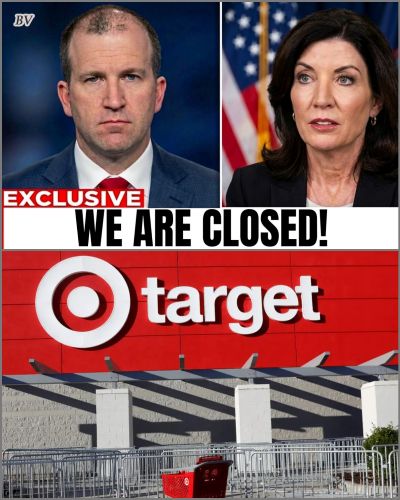
Target CEO Drops Bombshell Response to New York Leaders: Sky-High Costs, Rampant Theft, and Regulations Make NYC Untenable
In a dramatic escalation that has sent shockwaves through New York’s business community and political circles, Target’s CEO delivered a sharp, unapologetic response to city and state officials after the retail giant announced it was pulling back from multiple locations across the five boroughs and surrounding suburbs.
What officials expected — perhaps a contrite statement or promises to stay — turned into something far more explosive: a precise, cost-by-cost accounting of why operating in New York has become financially unsustainable for one of America’s largest and most recognizable retailers.

The closures and downsizing did not emerge from thin air.
Target had spent years and hundreds of millions of dollars building an ambitious urban footprint in one of the world’s toughest retail markets.
Smaller-format stores tailored for dense neighborhoods, expanded grocery sections, and integrated digital services were meant to prove that a national brand could thrive amid skyscrapers and high costs.
For a time, the strategy appeared visionary, bringing convenient shopping options to underserved communities and creating jobs in areas long overlooked by big-box retailers.
But reality hit hard.
Workers at affected stores received limited notice, sparking immediate panic among employees who had built careers, benefits, and family budgets around positions they believed were secure.
For neighborhoods already grappling with limited affordable retail choices, the news landed like another heavy blow to fragile local economies.

What was once hailed as long-term investment suddenly felt like a retreat, leaving residents wondering who would fill the void left behind.
City and state officials wasted no time expressing outrage.
Public statements framed the moves as corporate abandonment of communities that had welcomed Target with tax incentives, zoning breaks, and development partnerships.
Some accused the company of breaking implicit commitments after benefiting from public support to establish its presence.
The political pressure was intense and very public, with leaders reminding everyone that these stores were supposed to represent stability and economic vitality.
Yet when the CEO responded, he offered no vague platitudes or promises to reconsider.
Instead, he laid out a cold, data-driven explanation that cut straight to the heart of New York’s unique — and punishing — business environment.
The statement made clear that the challenges facing Target in New York were not minor fluctuations but structural disadvantages that set the city apart from almost every other market in the company’s national network.
Labor costs topped the list.
New York’s minimum wage ranks among the highest in the nation, and for a retailer relying on thousands of hourly workers, the difference multiplies rapidly into millions of dollars per store annually.
But base wages tell only part of the story.
Mandatory paid sick leave, strict predictive scheduling rules, and the intense competition for workers in one of the country’s tightest labor markets drive the true cost of employment even higher.
In an industry where profit margins often hover in the low single digits, these burdens create a permanent structural handicap rather than a temporary hurdle.
Real estate pressures compounded the problem.
Commercial rent in New York, even outside Manhattan’s core, far exceeds comparable markets nationwide.
Lease renewals have grown increasingly aggressive as landlords face their own financial strains.
Many of Target’s New York locations were signed during an optimistic expansion phase, when the company accepted short-term losses in hopes of building long-term market dominance.
That bet assumed steady foot traffic growth, operational improvements, and a stabilizing cost environment.
Instead, post-pandemic recovery proved uneven, efficiencies reached their limits, and renewal terms pushed many stores past the point of basic profitability.
The CEO addressed organized retail theft head-on, describing shrinkage levels in certain locations that have rendered consistent profitability impossible.
This is not an isolated issue for Target — major retailers nationwide have raised alarms about rising theft — but dense urban environments with high foot traffic amplify the exposure dramatically.
Mitigation efforts come with their own steep price tags: extra security personnel, advanced camera systems, locked display cases, and reconfigured store layouts.
Each measure reduces losses while adding operational expenses, yet none fully solves the underlying problem.
When shrinkage crosses a critical threshold, the combined cost of losses and defenses pushes locations into red ink that no realistic sales increase can offset.
Supply chain disruptions and tariff pressures added yet another layer of strain.
Imported goods have grown more expensive at the source.
In a price-sensitive market like New York, passing those costs to customers risks driving shoppers to competitors or online alternatives.
Absorbing them internally, however, further erodes already razor-thin margins.
These pressures do not replace the labor or rent crises — they stack directly on top, leaving marginal stores with no financial buffer.
Rather than portraying the closures as defeat, the CEO framed them as strategic reallocation.
Capital previously used to subsidize losing locations will now flow toward profitable stores, enhanced digital fulfillment, and same-day delivery infrastructure capable of serving New York customers without the crushing overhead of physical footprints in the nation’s most expensive zip codes.
From a pure business perspective, the logic is unassailable: every dollar spent propping up an unprofitable store is a dollar unavailable for growth elsewhere.
Officials pushed back forcefully, arguing that shifting to delivery ignores the realities faced by lower-income households — precisely the communities Target’s urban stores were designed to serve.
Many residents rely on physical stores for immediate needs, cash transactions, or the ability to inspect products in person.
A smartphone, credit card, reliable internet, and advance planning are not universal luxuries.
What corporations view as modernization, critics see as reduced access disguised as progress.
The broader retail landscape in New York echoes Target’s struggles.
Drugstore chains have shuttered dozens of locations.
Discount retailers and grocery stores have withdrawn from food-insecure neighborhoods.
The pattern is unmistakable: high costs, elevated crime-related losses, and thin margins are driving a selective retreat from the very markets that need affordable options most.
Each closure may appear isolated, but cumulatively they are hollowing out neighborhood retail infrastructure block by block.
What makes Target’s case particularly striking is the scale and the public nature of the CEO’s response.
This is no small regional player quietly exiting — it is a national powerhouse openly documenting, in specific terms, why significant portions of its New York footprint have become untenable.
That detailed explanation now enters the public record, destined to influence decisions by other retailers, investors, and city planners for years to come.
New York now confronts a larger, uncomfortable question: Has the city’s combination of wages, real estate prices, regulatory demands, and theft exposure reached a tipping point where thin-margin mass retail simply cannot survive? And if so, who steps in to serve the neighborhoods where a Target once provided the most accessible shopping within walking distance? No clear answer has yet emerged.
Target maintains it remains committed to New York through stronger digital channels and the select physical locations where performance still justifies the investment.
Officials counter that corporations have obligations extending beyond quarterly earnings reports.
Caught in the middle are the workers facing uncertain futures, severance questions, and a shrinking retail job market where new positions are appearing more slowly than old ones disappear.
By responding with such directness, the CEO fundamentally shifted the debate.
The conversation moved from accusations of abandonment to a sharper examination of New York’s underlying retail economics — a far more difficult discussion to dismiss with simple press releases or political rhetoric.
In the end, this episode reveals the raw tension between financial reality and community expectations in modern urban America.
Target’s CEO did not raise his voice or issue threats.
He simply laid out the numbers, explained why the math no longer works, and outlined a path forward based on cold economic logic.
Whether New York chooses to confront those numbers or continue demanding loyalty in the face of them may determine the future of retail — and accessible shopping — across the city for years to come.
The stakes are high.
Businesses vote with their feet and their balance sheets.
When even a giant like Target concludes that New York no longer works, the signal sent to the entire retail sector is impossible to ignore.
The question now is whether the city will listen — or risk watching more doors close for good.