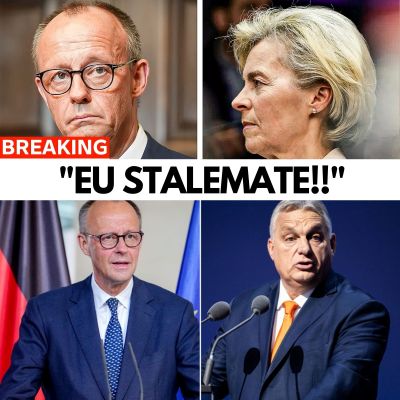
The European Union is facing one of its biggest political tests in recent years. What at first glance sounds like an ordinary dispute between member states has developed into an open power struggle that calls into question the stability and future of the entire alliance. At the center of this development is Hungary’s Prime Minister Viktor Orban – and a single word: No.
At the recent EU summit, there was an unprecedented showdown. For 90 minutes, 25 heads of state and government tried to dissuade Orban from his blockade stance. Leading politicians such as German Chancellor Friedrich Merz, French President Emmanuel Macron and EU Commission President Ursula von der Leyen made it clear how high the pressure was. It was about nothing less than billions in aid, strategic decisions and the political unity of Europe.
But Orban remained adamant.
His stance marks a turning point. While many EU states are pushing for a common line, Hungary is openly questioning the basic principles of cooperation. Orban argues that national interests must not simply be sacrificed for the sake of European decisions. He sees his country’s interests at risk, especially in the area of energy policy and economic stability.
The reactions from Brussels were not long in coming. Sharp words, threats of legal consequences and even discussions about the withdrawal of voting rights were loud. But a closer look shows that many of these threats are difficult to implement. Proceedings before the European Court of Justice can take years, and even drastic measures such as the withdrawal of veto rights require unanimity among the other member states.
This is exactly where the problem lies.
The EU is confronted with a structural dilemma. On the one hand, it wants to enforce its principles and demonstrate unity. On the other hand, it is dependent on the consent of all member states – even those that openly oppose the common course. This area of tension makes it clear how fragile the balance within the Union has become.
The situation is particularly explosive due to the economic background. According to various reports, it is not only about political principles, but also about tangible financial interests. Access to cheap energy sources plays a crucial role. Hungary benefits from comparatively low energy prices, while alternative supply routes would be significantly more expensive. These differences further increase tensions within the EU.
Other countries are also beginning to reconsider their positions. Slovakia is signalling support for Hungary and is also threatening blockades. This creates a dynamic that goes far beyond a single conflict. A potential bloc of states is forming that are willing to question the EU’s previous course.
This development has direct consequences for Ukraine. The planned financial aid is on the brink, while the country is struggling with massive economic challenges at the same time. Uncertainty is growing, and there is no clear way out in sight.
But the crisis goes even deeper.
It reveals fundamental questions about the functioning of the European Union. How much power should the institutions in Brussels have? How far can national governments go to defend their interests? And what happens when these two levels seem incompatible?
The coming weeks could be decisive. Another summit is planned, but expectations are subdued. Without a clear willingness to compromise, there is a risk of further escalation. At the same time, pressure from outside is growing. International observers are following developments closely and recognizing the increasing weakness within the EU.
For many citizens, a central question also arises: Who actually decides on the future of Europe? The elected governments of the Member States or the institutions of the Union?
Orban has not only blocked a political decision with his veto. It has triggered a debate that goes far beyond the current conflict. A debate about sovereignty, democracy and the limits of European integration.
One thing is certain: the European Union will not be the same after this crisis. Whether it emerges stronger or drifts further apart depends on how it deals with this challenge.
The conflict shows that unity cannot be taken for granted, but must be renegotiated again and again. And this is precisely the real test for Europe.