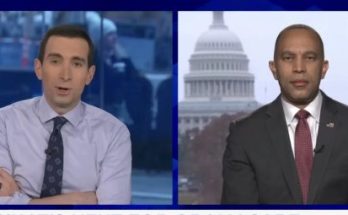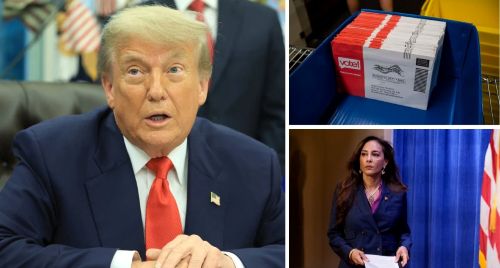
Assistant Attorney General for Civil Rights Harmeet Dhillon told Maria Bartiromo on “Sunday Morning Futures” that federal officials found tens of thousands of dead people and noncitizens on the voting rolls.
The Trump administration has sued several states for not giving the Department of Justice voter rolls. The DOJ is trying to make sure that the National Voter Registration Act, the Help America Vote Act, and other federal laws that protect the right to vote are followed. Dhillon informed Bartiromo that even in states attempting to adhere to the rules, they still discovered issues regarding voter eligibility.
“States are not in compliance, even those ones who want to. So, for the ones that we’ve run so far — 60 million records that we’ve run — we found at least 350,000 dead people currently on the voter rolls in those jurisdictions, and we’ve referred approximately 25,000 people with no citizenship records to [the Department of] Homeland Security to look at, you know, dig into that further and see the extent to which people voted,” Dhillon told Bartiromo.
“I’m in touch with voting rights activists who are showing me information about people who have voted who are not American citizens. So the Left told us this never happens and it’s a myth, it definitely happened,” Dhillon.
“Just recently, someone was indicted in Minnesota, of all places, for voting without being a citizen, and so I’ve sent a document request to them on that,” Dhillon continued. “Minnesota has a weird vouching law that allows citizens to vouch for each other’s citizenship. That’s crazy and inconsistent with the Help America Vote Act and we’re not going to rest until we complete this project.”
Dhillon also noted that, despite the Civil Rights Act of 1960 giving the attorney general access to voting rolls to ensure compliance with the law, multiple states have refused to hand them over.
“I’m suing 29 states and the District of Columbia for their refusal to give us the voter rolls to which the attorney general or the acting attorney general is entitled under the Civil Rights Act of 1960,” Dhillon told Bartiromo, later adding that, in several cases, federal judges ruled against the Trump administration.
“We’re expediting the appeals in these cases,” Dhillon said. “There’ll be an appeal in the Ninth Circuit [Court of Appeals] and the Sixth Circuit soon.”
WATCH:
Senate Republicans recently moved the SAVE America Act forward, setting up a renewed legislative fight this week over election rules as GOP leaders signal the bill will be a top priority in the coming weeks.
The Senate voted 51–48 to advance the legislation last week by approving a motion to proceed, clearing a key procedural hurdle and allowing formal debate to begin.
The measure now returns to the floor after previously stalling, with Sen. Mike Lee urging conservatives to maintain pressure on lawmakers to ensure final passage.
The proposal has also received strong backing from President Donald Trump, who has made election integrity a central issue of his second term. In a recent statement, the White House said the administration views the bill as a key part of its broader agenda on election security.
Supporters of the SAVE America Act claim it aims to bolster confidence in federal elections through the introduction of new requirements and oversight mechanisms.
The bill would require proof of U.S. citizenship when registering to vote in federal elections, tighten voter identification rules, and expand federal involvement in maintaining voter rolls.
Republican lawmakers argue these changes are necessary to ensure that only eligible citizens participate in elections and to address concerns about how voter registration systems are managed. They also contend that such measures reflect widespread public support for stronger election safeguards.
Despite clearing the procedural vote, the bill faces a difficult path to final passage.
Under current Senate rules, most legislation requires 60 votes to overcome a filibuster, meaning Republicans would likely need support from at least some Democrats unless procedural rules are changed.
Republican leaders have indicated they intend to hold an extended floor debate, a move that would keep attention on the issue and require senators from both parties to publicly take positions on the bill.