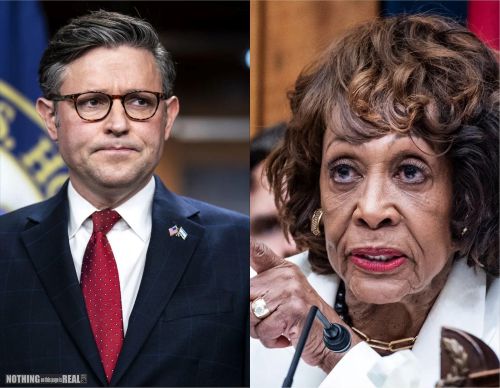
Washington, D.C. — Speaker of the House Mike Johnson took decisive action on a matter of growing controversy within Congress, filing a motion with the House Committee on Rules and Procedures to begin the process of restricting or outright eliminating the practice of voting by proxy. His filing, which singles out Representative Maxine Waters (D‑CA), has sparked fierce debate about the integrity of congressional procedures, the accessibility of representation, and the ongoing impact of COVID-19-era measures.
The motion, introduced last week, claims that Waters, despite being absent from the House chamber for several months, continues to have her vote counted in legislative proceedings via the proxy voting rule. Johnson argues that this practice undermines the purpose of democratic representation, calling it a loophole that allows for absentee voting without oversight, transparency, or accountability.
In his motion, Johnson states:
“Congresswoman Waters hasn’t been in the House chamber in months,” continuing, “Yet her vote is always registered. It’s time to eliminate the procedural loophole that allows that to happen.”
He further outlines his frustration with the current system, invoking imagery to underline his argument: “That rule needs to go so we don’t have zombies voting from a rocking chair three thousand miles away.” The metaphor, sharp and evocative, has been met with both praise for its clarity and criticism for its apparent mockery of an issue that affects many Americans.
The Origins and Context of Proxy Voting
To understand Speaker Johnson’s motion fully, it’s necessary to delve into the history and context of proxy voting in the United States House of Representatives. Proxy voting, as we know it today, was implemented as a temporary rule in the House during the COVID-19 pandemic. Initially passed in May 2020, the rule was intended as an emergency measure to address the public health risks posed by the virus. It allowed members of Congress who could not physically attend votes due to health reasons, quarantines, or travel restrictions to appoint a colleague to cast their vote on their behalf.
The proxy voting measure was put in place to ensure that the business of the House could continue without endangering the health of members, their staff, or the public. During the early months of the pandemic, with members of Congress scattered across the country and lockdowns in place, the measure allowed for continuity in the functioning of the legislative body, particularly in passing essential bills, including those related to COVID relief.
However, despite the pandemic fading in the public consciousness, the rule has remained in place, much to the consternation of some. Critics, including many Republicans, argue that proxy voting was never meant to be a permanent feature of the House and that it undermines accountability, transparency, and the principle of in-person representation. House Speaker Mike Johnson, now at the helm, is one of the rule’s most vocal critics.
In his motion, Johnson argues that while proxy voting was a temporary measure during an emergency, it has now been used as a means to avoid the rigors of attending the House in person. This practice, in his view, has been exploited by members who seek to bypass the responsibilities that come with physically engaging in the legislative process.

Maxine Waters and the Proxy Voting Issue
The motion specifically singles out Representative Maxine Waters, who, according to Johnson’s filing, has not attended the House chamber for months yet has continued to have her vote recorded through the proxy voting system. Waters, a longtime representative from California, has been a fixture in Congress for more than three decades, known for her outspoken advocacy on issues related to civil rights, economic justice, and community empowerment.
Waters, who serves as the chair of the House Financial Services Committee, has been one of the most prominent figures in Congress, not just for her policy stances but also for her leadership and political influence. She has a long history of working toward systemic change, and her presence in Washington has been an essential part of the political landscape. However, her absence from the House chamber amid ongoing proxy voting has raised questions about the extent to which her vote is being used to influence legislation without her physical presence.
For many of her supporters, Waters’ absence from the chamber is understandable given the ongoing challenges of the pandemic and the fact that she is an older member who may have health concerns. They argue that proxy voting has allowed people like Waters to continue representing their constituents without jeopardizing their health, especially in the face of medical concerns that might prevent them from attending in person.
Yet, Johnson’s motion specifically targets Waters, suggesting that the ongoing use of proxy voting in her case is part of a broader systemic issue. By focusing on Waters, Johnson is not just challenging her personally, but questioning the broader ethics and fairness of proxy voting itself. For Johnson, the issue is not necessarily whether Waters has legitimate reasons for being absent but whether the system should allow votes to be cast on behalf of members who are not physically present, potentially creating discrepancies in representation.
The Argument for Eliminating Proxy Voting
Johnson’s broader goal is to eliminate the practice of proxy voting, which he believes weakens the legislative process. He argues that elected representatives should be required to physically attend votes to ensure they are fully engaged in the legislative process and are held accountable for the decisions they make.
In his motion, Johnson writes:
“This loophole, introduced under the guise of an emergency measure, has become a convenient means for absenteeism without the transparency that the American people deserve. It’s time we restore the integrity of the legislative process by eliminating proxy voting.”
Johnson’s motion speaks to a fundamental belief held by many conservatives—that in-person attendance is an essential part of fulfilling one’s duties as an elected representative. He contends that proxy voting gives too much power to other members of Congress to represent individuals who are absent, thus diluting the principle of direct representation and accountability. To Johnson and his supporters, voting by proxy may be seen as an easy way for members to avoid the rigors of attending every session while still having a say in important votes.
Moreover, Johnson has positioned this motion as an issue of fairness. By highlighting the case of Maxine Waters, Johnson is calling attention to the potential for procedural abuses. He argues that some members may be using proxy voting as an opportunity to avoid their responsibilities in the House without suffering any consequences, all while continuing to exert influence over critical votes.

“Zombies Voting” — Johnson’s Provocative Rhetoric
The most provocative aspect of Johnson’s motion is his metaphorical description of proxy voting as “zombies voting.” In his statement, Johnson writes:
“We don’t need zombies voting from rocking chairs three thousand miles away. Our democracy deserves better.”
This vivid imagery has sparked backlash from some, who view it as an attempt to dehumanize and dismiss the legitimate concerns of those who may not be able to attend due to health, travel, or other valid reasons. To Johnson’s critics, this rhetoric is not only inflammatory but deeply divisive. It suggests that members who rely on proxy voting are less committed to their roles, undermining their ability to perform their duties fully.
Supporters of proxy voting, including many Democrats, have called Johnson’s remarks offensive, arguing that it dismisses the challenges faced by older members or those with medical concerns who still wish to contribute to the legislative process. In response, many have suggested that the system could be reformed rather than eliminated entirely to address these concerns without completely removing the option for those who need it.
Political and Procedural Consequences
The motion filed by Speaker Johnson has set the stage for what could be a significant procedural shift in the House of Representatives. If the House Rules Committee approves the motion and it is passed by a full House vote, the change could effectively end the practice of proxy voting for good.
However, the potential fallout from such a decision is considerable. For many members of Congress, especially those who have relied on proxy voting in recent years, such a move would represent a major loss of flexibility. It could make it more difficult for those with valid reasons for absence to continue their work in Congress without fear of their absence being held against them.
On the other hand, critics of the current system argue that eliminating proxy voting would restore accountability and prevent abuse of the system, ensuring that members of Congress are fully engaged in the work they were elected to do. If the motion is successful, it could set a new precedent for how absenteeism is handled in Congress moving forward.
What’s Next for Proxy Voting?
As the motion to eliminate proxy voting moves through the House, it remains to be seen how much support it will gain from members on both sides of the aisle. While Republicans, led by Speaker Johnson, have expressed a clear desire to end the practice, Democrats may push back, arguing that the measure has been a necessary accommodation for members who cannot attend in person due to health, safety, or logistical reasons.
Ultimately, the fate of proxy voting will depend on the political will of the House and whether a compromise can be reached that balances the need for in-person representation with the realities of modern life.
In the meantime, Speaker Mike Johnson’s motion will continue to fuel debate about the fairness, transparency, and integrity of congressional procedures. Whether or not the Born-In-America Act or other similar measures ultimately pass, the discussion around proxy voting has already become one of the most contentious issues of the current legislative session.
For now, the battle lines are drawn, and the outcome of this dispute could significantly shape the future of how Congress operates.